
Kopi O'Clock
The Caffeine, Customisation, and Culture of Singapore's Favourite Brew


Uncle! One Kopi-C Tilo!
That’s been my go-to kopi order for as long as I can remember - second only to the milo siew dai of my childhood.
Kopi, as we know and love it, is a drink born of adaptation. Hainanese immigrants working in British households learned Western-style brewing, but reimagined it using local, affordable ingredients and techniques.
A defining feature of Southeast Asian coffee culture is the ubiquity of the robusta bean. European-style coffee - often made with arabica - was, and still is, relatively expensive. Robusta beans are, on average, half the price of the more well known Arabica bean. Fresh milk was substituted with condensed milk, which held up better in the tropical heat and the lack of widespread access to refrigeration. This works perfectly, complementing the naturally bitter profile of robusta beans, especially given how we tend to roast them extra dark. Every single component in kopi has a history and a story.
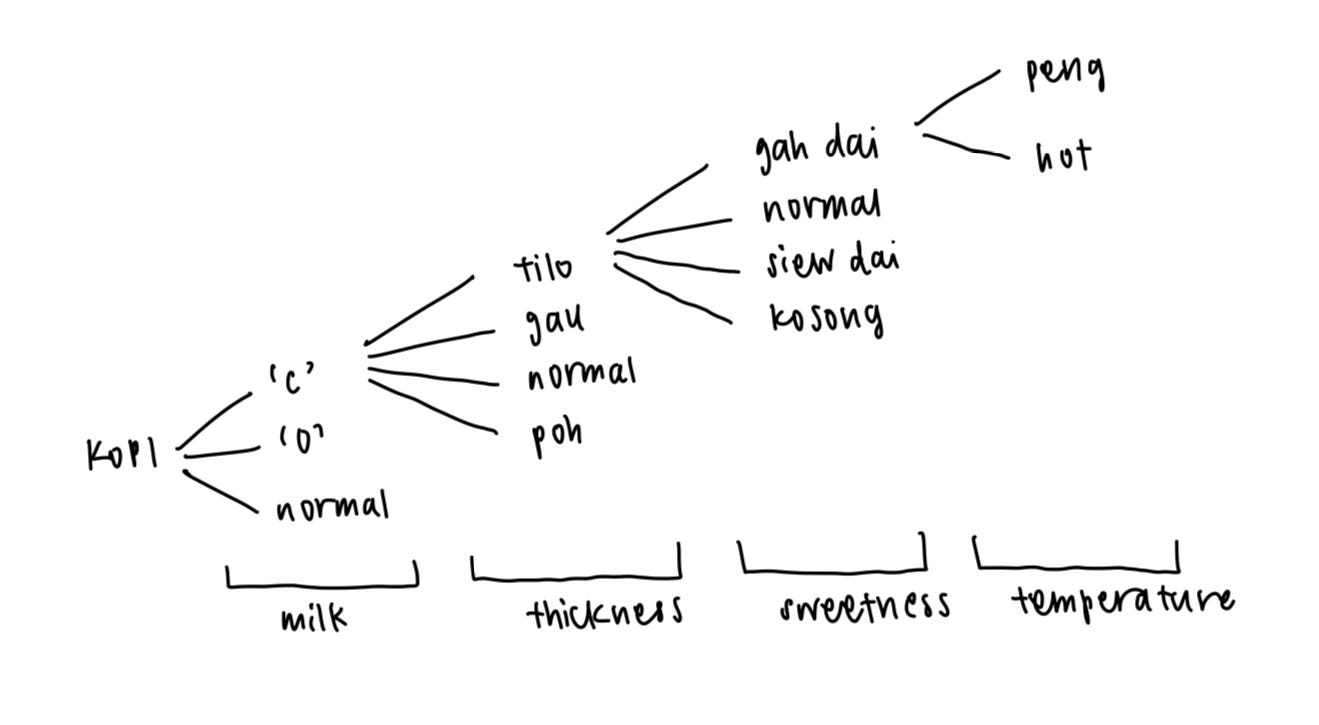
Even the naming conventions behind kopi constitute almost a secret language among Singaporeans. To an outsider, this code seems near-impossible to decipher. To Singaporeans, it offers us unparalleled customisation. With four levels of customisation - milk, thickness, sweetness and temperature - something as humble as a cup of coffee can take on a whopping 96 different forms. This is a level of personalisation most Western coffee menus can only dream of. If we add my personal favourite, the unique kopi gu you, we’re up to 97. This one has a special place in my heart. If you haven’t tried it, I suggest you order it at my favourite coffee shop (location linked below). I’m not counting kopi with egg since the only person I’ve known to ever order that is my late grandfather, but perhaps one of you may enlighten me.
The Dose Makes the Poison
Robusta beans, on top of being the cheaper bean variety, also tend to be stronger than Arabica beans. It has almost double the caffeine content of arabica beans.
Several factors affect the quality and caffeine content of coffee beans. A group of researchers in Indonesia conducted a first-of-its-kind study that measured the caffeine content of robusta beans according to bean variety and roasting methods.
We thus estimate that a standard serving of traditional kopi in Singapore contains approximately 230 mg of caffeine. That’s equivalent to 3.5 shots of espresso! Or if you’re like me and order a kopi tilo (translates to ‘direct pour’ in dialect ie. undiluted kopi), you could end up consuming the equivalent of 5 shots of espresso in one sitting.
Here’s how kopi stacks up against other familiar beverages in both caffeine content and cost per cup.
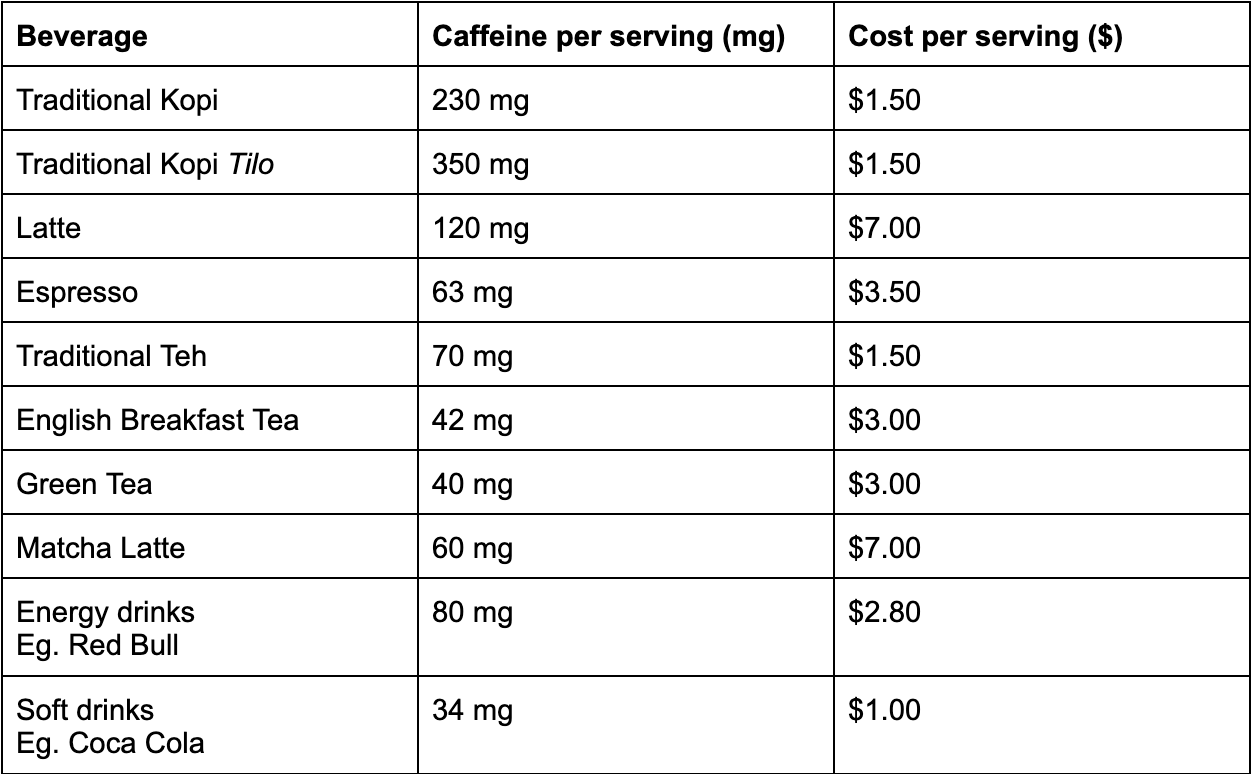
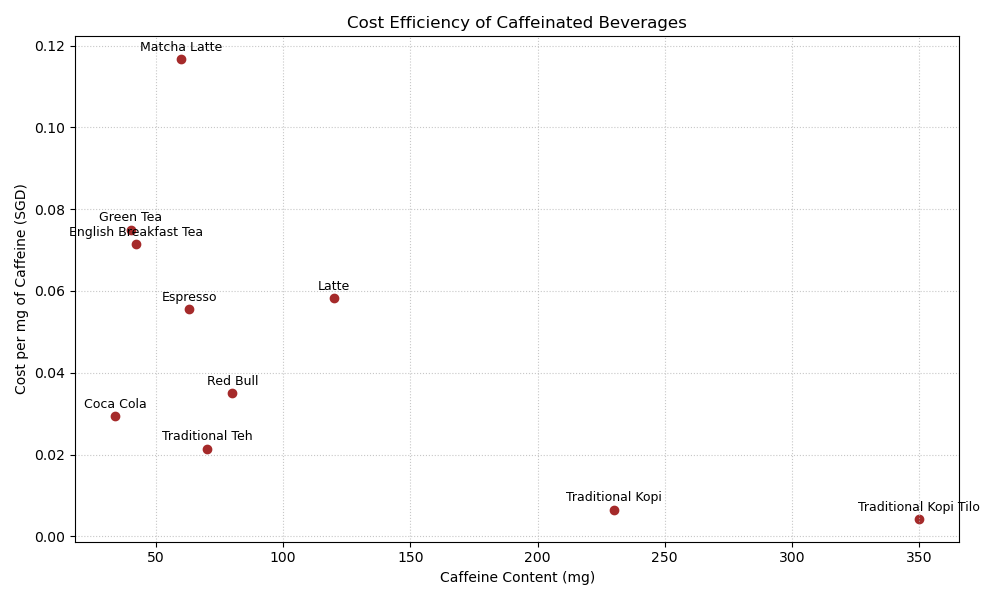
In both the caffeine content and caffeine-to-cost ratio, kopi reigns supreme - as you’ll see in the chart below. With a tilo order, you can get 300 mg of caffeine for just $1.50 at your neighbourhood kopitiam. There’s few things we Singaporeans love more than extreme efficiency, and kopi epitomises that. And in my personal (very biased) opinion, it is the best tasting of the lot.
Studies have linked moderate coffee consumption with positive health outcomes, ranging from reduced risks of diabetes, cardiovascular diseases, neurodegenerative disorders to the antioxidants helping to reduce inflammation. You’re welcome, to those of you who maybe need some justification for their coffee addiction habit.
However, too much caffeine can lead to anxiety, restlessness, digestive issues, and - ironically - poorer sleep, which then creates a feedback loop that drives even more coffee consumption. Medical journals and health agencies generally agree that 400mg of caffeine per day for a healthy adult is not affected by adverse health effects. That’s just under two cups of kopi.
The Timing Makes the Poison
On top of how much caffeine you are consuming, when you consume it matters too.
Caffeine content in our bloodstream is governed by something called a half-life. The half-life governs the decay of many substances around us, from caffeine all the way to the decay of nuclear isotopes. It tells us how much time it takes for the amount of caffeine in your bloodstream to halve. This value varies between individuals - for example, it tends to be longer in children and shorter in smokers.
On average, it takes our bodies about 6 hours to break down half of the caffeine in our bodies. This means that if you consume 200 mg of caffeine in your 8am breakfast, your body will have about 100 mg in it by 2pm. Just in time for the after-lunch slump. And 50 mg by 8pm, 25 mg by 2am and so on. Until you drink the next cup of coffee, of course.
If you are anything like me, you drink 2 cups of kopi a day - one in the morning before starting the day, and another one after lunch to combat the afternoon slump. Now, with multiple cups consumed, potentially at different times of the day, the numbers are not quite as straightforward. So let’s visualise it.
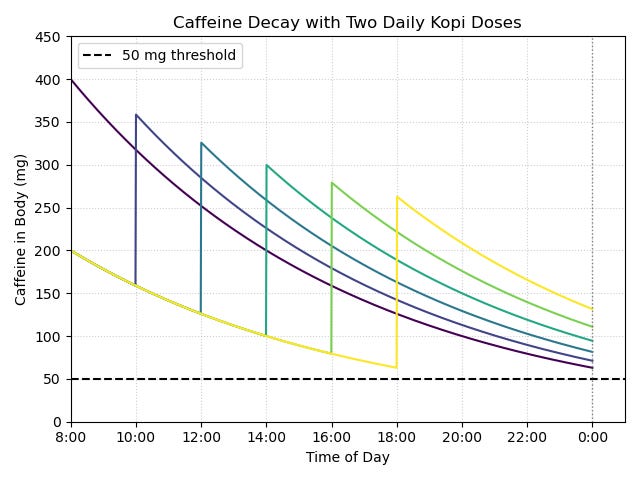
Perhaps unintuitively, consuming the same 2 cups of kopi at different times of the day can leave you with vastly different levels of caffeine in your system by bedtime. We tend to assume that the longer we wait, the more caffeine wears off - as if it burns away at a steady, constant rate. But caffeine decays exponentially, not linearly. This means that the effect of your afternoon kopi can linger well into the night.
And this is not even accounting for those of us who throw back more than 2 cups a day - every subsequent cup of kopi stacks onto the remnants of your morning brew. Think of your body’s caffeine levels like a tide. Each cup is a little wave. It crashes up and recedes slowly. But when another wave comes before the last one fully recedes, the tide stays high. Drinking three or four well-timed cups across the day and you’re essentially riding a high tide late into the night.
The general advice is to aim for no more than ~50 mg of caffeine in the body by bedtime for your sleep quality to remain unaffected. Of course, every individual has a different caffeine threshold and I envy those of you who can fall asleep even after drinking kopi past 5pm.
Other than quality of sleep, there are also longer-term health implications for timed caffeine consumption. One clinical study even found that drinking coffee in the morning is more strongly associated with lower risk of mortality than drinking coffee later in, or throughout the day. If you’re drinking coffee for the health benefits, then you might want to look into drinking it all before lunchtime.
That’s a lot to think about for just a simple cup of kopi - but maybe that’s what makes it so fascinating. Kopi, while ubiquitous in Singapore, serves us all in different ways. Kopi keeps some of us awake through painful all-nighters. Kopi brings our communities together in kopitiams. However kopi fits into your life, we all stand to gain from being more intentional, informed, and appreciative of this well-loved beverage.
In my personal life, it has always played an integral role in not only my routine, but also my social life. Here’s my personal favourite spots on the island. I hope you check them out, and see the charm in them that I do.
Kopitiam: Heap Seng Leong Coffeeshop
Kopi powder: Lam Yeo Coffee Powder Factory
Let’s settle the debate - what’s the best kopi order out there? Let us know what your preferred kopi order is in the comments below.
 | A guest post by
|